The enterprise control plane and harness
Frontier quality.
Open-model prices.
mo's modular architecture replaces a patchwork of individually managed tools with one governed path for every AI request, anchored by a single control plane for cost, permissions, and model approval. mo eval continuously verifies routing decisions against your own code, cutting the time developers wait on responses and spend by 75%*, without changing the tools they already use.
*"twice as fast, 4x less expensive" vs. Claude Code
brew install momentohq/tap/momo login. macOS and Linux only for now.
mo eval
Determine the best models for your workloads
Your engineers already have coding agents and harnesses. mo eval decides which models they should use and how, benchmarked on your real repository tasks, in your environment, with the toolchain your team already uses.
- The production tools do the work. Claude Code, Pi, or mo itself, running the task, tools, and skills end to end the way your developers actually work.
- The gateway meters it. Every call on approved routes, under the same budgets as daily work, behind zero data retention.
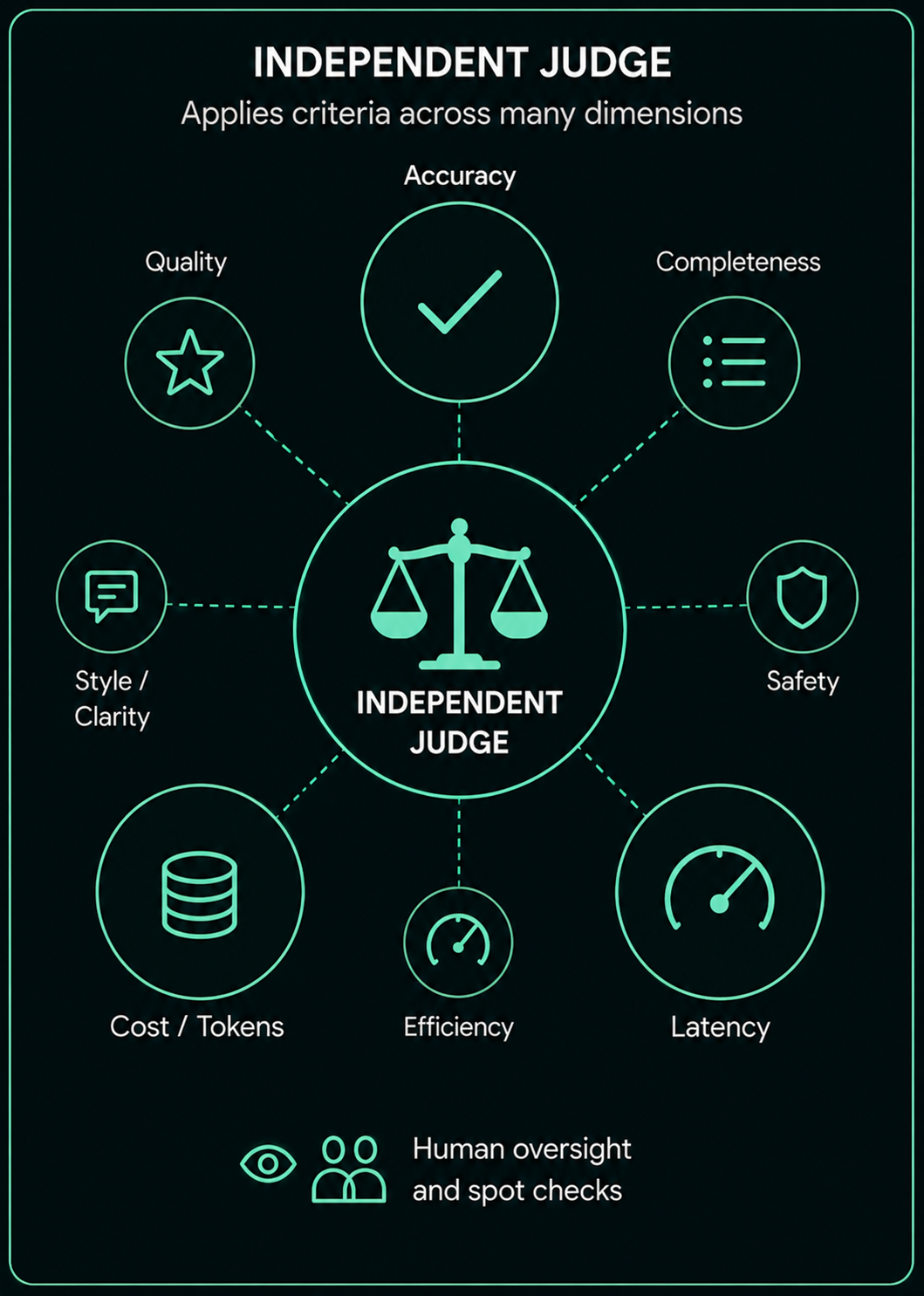
- Evals determine the production routing. Benchmarked against your own code and tasks, not a generic public leaderboard, with acceptance tests gating each result and an LLM judge validated against human-labeled samples before its grades are trusted.
- Continuous improvement is a configuration change. The model that wins becomes a routing rule you apply on approval, instead of a migration, and mo eval re-benchmarks automatically as new models ship, so the rule doesn't go stale.
mo eval Benchmarks
Cost and quality, side by side
Real benchmark results from 6 production repos containing real tasks, scored by an independent multi-model judge panel.
Metered cost per task set
indexed to Claude Opus 4.8 = 1.0×
shorter is cheaper
Judge-panel quality
mean score on a 0 to 5 scale
both passed 6/6 automated suites
The harness matters too: on the same model, native mo ran up to 4× cheaper and ~2× faster than Claude Code, with no measurable quality difference.
Bring your own agent
Keep Claude Code.
Change its plumbing.
mo launches the harness you already use, unchanged, through the gateway, with model choice, budgets, and zero data retention included.
mo ccClaude Code, zero-data-retention pipemo piPi, zero-data-retention pipeEnterprise governance
The controls an admin needs
All of this is enforced at the gateway, the same layer mo eval's tests run through. See how it's built →
Budgets
Per-user daily/monthly ceilings. Hard 402 at the limit; every response carries available usage in a header.
Keys
Mint, scope, revoke in seconds. Virtual keys restrictable per model route. No redeploys.
Metering
Every request, one record, errors included, rolled up per user, team, org, and project. Optional SSO dashboard.
Permissions
Plan & Build modes. Agents stay read-only until the developer approves; ambiguous commands are blocked by a model-backed safety judge instead of guessing; hard-deny rules ship built in and no local config can override them.
Sharing
/grant a live session to a named teammate. Time-limited by default, visible to the owner, revoked with one command — and credentials never leave the gateway.
Remote
Approve from your phone. Watch, prompt, and approve or deny gated actions from a paired mobile client.
Compare
Where mo sits
| mo | Pi (open source) | Claude Code | |
|---|---|---|---|
| Permission system | Plan & Build modes, model-backed safety judge, configurable allow/ask/deny tiers | None built-in; runs with your full user permissions | Per-action approvals and allowlists |
| Where your code travels | Through a zero-data-retention gateway; records are metadata-only | Straight to each model provider, on your own keys | To the model provider, per its data policies |
| Models | Frontier and open (Claude, GPT-5.5, GLM-5.2, DeepSeek), one string to switch | Multi-provider, bring your own keys | Claude models |
| Automatic model routing | Phase shift: hard reasoning on a frontier model, routine work on an open model, automatically | None | Plan-vs-execute split, Claude models only |
| Budgets & metering | Per-user ceilings with hard stops; rollups per user, team, org, and project | None | Varies by plan |
| Team visibility | Session sharing, live metadata tail, phone-based remote approvals | None | Varies by plan |
| Runs other harnesses | Yes: mo cc and mo pi route them through the same gateway |
None | None |
Scope: coding-agent harnesses (the tools a team would otherwise standardize on), not general LLM gateways or IDE assistants. Based on public documentation, July 2026. Pi is a minimal harness and does that job well. mo exists for teams that need the enterprise layer around one: privacy, budgets, and visibility.
Enablement
What we do with your platform team
Moving real coding volume to open-weight models is an engineering decision, and it needs data. Momento runs embedded enablement engagements that give your platform team the data to make the call, and the tooling to retest every time a new model ships.
Evals
A benchmark suite for your workloads. Built on the tasks your teams run (code review, bug fixes, migrations, incident triage), scored against the frontier baselines you already pay for, with an LLM judge that's validated against human-labeled samples before its grades are trusted. Verifiable against every new model release.
Bake-offs
Providers, measured on your workload. The managed inference providers serving your shortlisted models, raced head-to-head: time-to-first-token, p95/p99 latency, sustained throughput under concurrency, availability, consistency, and price. The winner is wired into your gateway routing, and the race reruns as providers evolve — so your deployment keeps improving instead of going stale.
Self-hosting
Open-weight models on your hardware. Open-weight models stood up on your own hardware (vLLM/SGLang, FP8/FP4), behind your gateway, inside your perimeter. Measured against the managed options down to break-even volume, and handed off as reusable Terraform.
Delivered as embedded sprints with your engineers: architecture deep-dives (mixture-of-experts, attention and KV-cache design), provider landscape briefings, and a full handoff, so your team can re-run everything without us. Ask about an enablement engagement
Security & Privacy
What your security review will ask
Who is Momento?
The team that runs serverless infrastructure for enterprises in production; the gateway runs on that same platform. The pieces a reviewer usually checks: zero data retention, allow-listed egress, fail-closed auth.
What does the gateway store?
No prompt, code, or reply content. Zero data retention is enforced on every request, and what the gateway keeps is a metadata-only usage record carrying tokens, cost, timing, and identity. The current prompt and reply are relayed to the session owner, and to a teammate while a session is shared; neither is stored.
Where can our traffic go?
Only to the provider you chose, and per-key route restrictions keep teams on approved providers. Headers reach a provider only from a fixed allow-list. Your Momento credential is dropped, and the OpenAI-compatible routes forward no caller headers at all.
What credential sits on a developer's laptop?
A vended token that expires within the hour and is re-vended, never extended. Provider keys stay in the gateway.
Can a provider key leak back to a caller?
The gateway prevents provider keys from propagating in upstream error responses.
What if the key store is unreachable?
Auth fails closed. Requests are rejected rather than waved through.
We already have an Anthropic agreement.
Keep it. The anthropic/ route is a transparent passthrough: bring your own key under your existing terms; mo adds metering and harness guardrails around it.
How do we offboard someone?
Access rides on revocable keys, re-read on every request, so revocation is immediate and needs no redeploy. A session token already issued to that developer keeps working until it expires, up to an hour.
Platforms and pricing?
macOS and Linux via Homebrew today. Usage is metered per request with budget ceilings on top; commercial terms: hello@momentohq.com.
Get started
Install mo and run your first session
brew install momentohq/tap/moThen run mo login and pick a model. Click here for Linux builds.